Venue
This page contains information related to Conference locations, logistics and local attractions.
For general inquiries, please contact the Local Organizing Committee.
In case of special requests or inquiries, please contact the Conference Chairs or the appropriate Committee Coordinator.
City
The 8th edition of WEMDCD will be held in Pisa, a lively mid-small city with a long history dating back to the pre-Roman era.
It is located close to the seaside in the mid-northern part of the Tuscany (Toscana) region of Italy, about 70 km to the west of the regional capital Florence (Firenze).
Pisa is a university city, home to three academic institutions:
- The University of Pisa, one of the oldest in the world as it was officially founded in 1343 although earlier academic activities have been traced back to the 11th century. It features a very broad range of fields: from most of the engineering disciplines, to computer science, mathematics, physics, chemistry, medicine, biology, economics, law, literature, foreign languages, history, philosophy, and more.
- The Scuola Normale Superiore, founded in 1810 during the Napoleonic era based on the model of the French École Normale Supérieure; today it supports outstanding students in classical fields such as physics, mathematics, philosophy, literature, and more.
- The Scuola Superiore Sant'Anna, founded in 1987, which supports outstanding students in more recent, application-oriented fields such as engineering, economics, law, and more.
Pisa, as well as the neighbouring cities such as Lucca, and the whole Tuscany region in general, are rich in remarkable monuments and beautiful natural features, offering a lot of opportunities to enjoy the visit as better described in the section dedicated to Attractions.
Conference Location
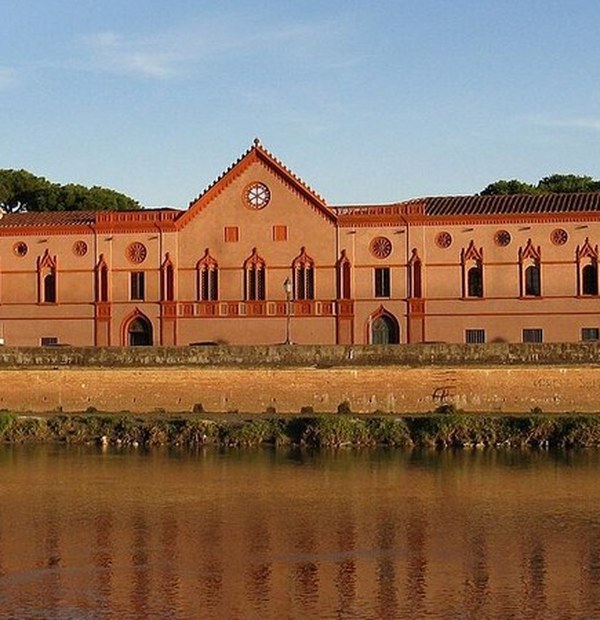
The sessions of WEMDCD 2027 will be held at the Congress Centre Le Benedettine, a former monastery for nuns dating back to the 14th century. It was acquired some years ago by the University of Pisa in order to be renovated for hosting Conferences, exhibitions and specific teaching activities; part of the building was also converted into a short-term residence for academic guests.
The Congress Centre is located on the southern bank of the river Arno, with entrance at Piazza S. Paolo a Ripa D'Arno 16, 56122 Pisa.
More detailed information, including the building map and the location of the rooms hosting the different activities, will be provided later on.
Connections
Pisa is very well connected and easily reachable using different transportation systems.
Traveling by Flight: the Pisa "G. Galilei" Airport, located quite conveniently at the southern periphery of the city, is a mid-size hub offering many connections across Italy and Europe, mostly low-cost, as well as some longer-range connections outside Europe.
The Florence "A. Vespucci" Airport can also be easily reached by train and tram, opening up a further range of mostly low-cost connections.
Traveling by Train: main routes towards Rome and Genoa, a fast route to Florence, and a slower route to Lucca, all operated by Trenitalia from the main station Pisa Centrale and the secondary station Pisa S. Rossore.
By connecting in Florence SMN station, the high-speed rail network can also be accessed, including other operators such as Italo.
Traveling by Coach: multiple short-range and long-range connections are available to many cities, mostly in Italy, provided by different bus operators including Autolinee Toscane, FlixBus, MarinoBus, CaronnaTour.
Traveling by Car: besides the local road network, the Firenze-Mare Highway A11 and the FI-PI-LI motorway are available for moving inland, whereas the Genova-Rosignano Highway A12 is easily accessible for moving along the seaside route. These major routes also permit to connect with the whole network of Italian Highways.
Traveling by Ship: the nearby main port of Livorno can be easily reached from Pisa by train and local transportation, permitting also to access regular ferry connections to Sardinia, Corsica and Sicily.
Local Mobility
In the whole Tuscany region, the public Bus service is provided by Autolinee Toscane, with several lines running through Pisa.
The Taxi service based in Pisa is operated by CoTaPi. Several companies provide also NCC services (car-with-driver private rental) in the area.
Inside Pisa, an electric Bike and Scooter rental service is available from BIT.
Moreover, inside the city a convenient public Bike rental service is provided by CicloPi.
Anyway, Pisa is small enough that the city centre can be comfortably explored by foot, a perfect way to fully enjoy the visit for those who like walking.
Both the train stations, and even the airport, can also be reached by foot from the city centre.
Accommodation
Since Pisa is a popular tourist destination, a lot of accommodation options are available throughout the city within walking distance and beyond, in both Hotels, B&Bs and private apartments.
In addition to their own individual websites, these properties can usually also be reserved via popular portals, such as Booking , AirBnB etc.
The Residence Le Benedettine offers a limited number of rooms in the same building as the Congress Centre.
Anyway, since the Conference will fall around the Easter break, when a lot of tourists are expected to visit the city, the prospective participants are advised to arrange their accommodation as early as possible, in order to get more options and more affordable prices.
Attractions
The city of Pisa still preserves several buildings and remains dating back up to the pre-Roman era, featuring several monuments that deserve to be visited.
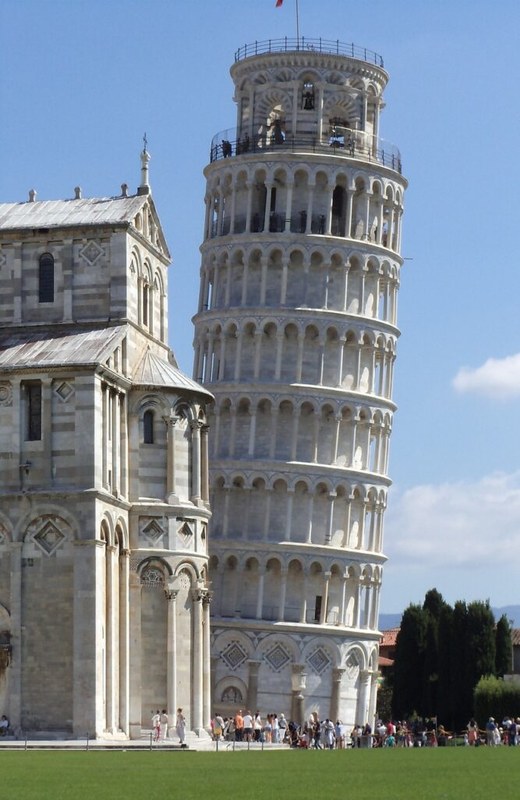
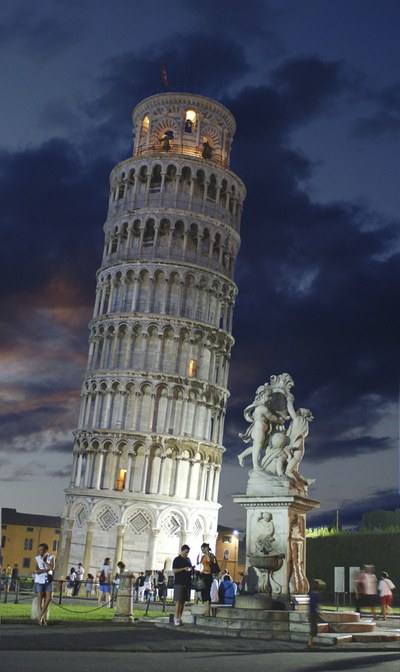
The most famous attraction in Pisa is by far the impressive and worldwide renowned Torre Pendente or Leaning Tower, actually a 56 m high Bell Tower completed in 1372 after almost 2 centuries of work.
It represents the gem of the stunning square named Piazza dei Miracoli, where also the Cathedral, the Baptistry and the Monumental Cemetery stand as remarkable memories of the medieval period of utmost power and wealth of the city, in the beautiful framework of the ancient walls.
In fact, for some time the independent Republic of Pisa emerged as a major maritime power in the Mediterranean area, boasting a powerful fleet with skilled sailors and brave knights who were able to create and protect a wide and profitable network of trading routes and overseas colonies.
Such wealth was also partly invested in building an impressive set of monuments related to one of the dominant factors of life at the time, i.e. religion, in order to get protection from God, to please the population, and to increase the prestige of the city by reassuring the allies while instilling fear in the enemies.
Nevertheless, the large free lot selected for the purpose at the northern periphery of the city turned out later on to be not the best: in fact, it lacked a rock bed while the soil was somewhat unstable and prone to slowly subside because in older times a river flowed just there before being buried.
During construction, both the Cathedral (especially the main facade), and even more the taller Bell Tower, were then affected by uneven soil settlement phenomena, which gave rise to the quite unintentional yet very visible "leaning effect".
Since the building investment was huge, while the period of peak wealth of the city lasted relatively little time, the monuments were ultimately completed in a long timespan in the place originally planned; nevertheless, in the end what was initially seen as a half-failure turned into such a peculiar feature that the "Torre di Pisa" became the most famous "leaning tower" in the world.
Anyway, the leaning angle of the Tower grew in time until, about 35 years ago, the monument was deemed to be in real danger of collapsing. Therefore, after a careful analysis and planning phase, an outstanding and quite delicate recovery and stabilization intervention was undertaken using advanced engineering solutions, finally succeeding in 2001 when the Leaning Tower was re-opened to the public.
In fact, nowadays it is able to attract thousands of visitors per day from all over the world, who never miss the chance to take all types of photos, including the iconic "support the Tower" challenge.
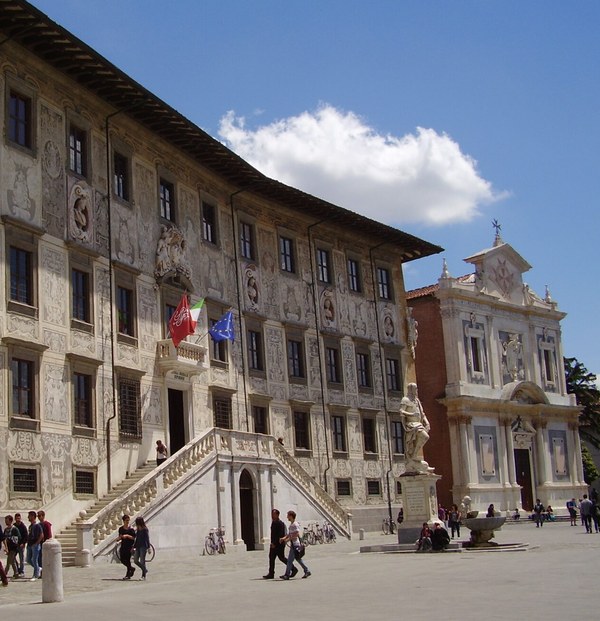
The second most remarkable square in the city is Piazza dei Cavalieri, where three historical buildings are found:
- Palazzo della Carovana, a noble palace initially used as the seat of the Order of the Knights of Saint Stephen, then passed on to the Scuola Normale Superiore to be used as its main place since its foundation;
- Chiesa di S. Stefano, formerly the Church of the Order of the Knights of Saint Stephen, now a museum hosting many trophies conquered during the multiple fights mainly against Saracen pirates and Turkish armies, including the famous naval battle of Lepanto.
- Palazzo dell'Orologio, the former tower where, according to the tradition, the deposed tyrant of the city Ugolino della Gherardesca was imprisoned and condemned to death by starvation together with his sons and grandsons; according to the probably fake story also mentioned in the famous poem Divina Commedia, when pressed by hunger he did not refrain from killing and eating his own offspring, thus confirming his evil nature.
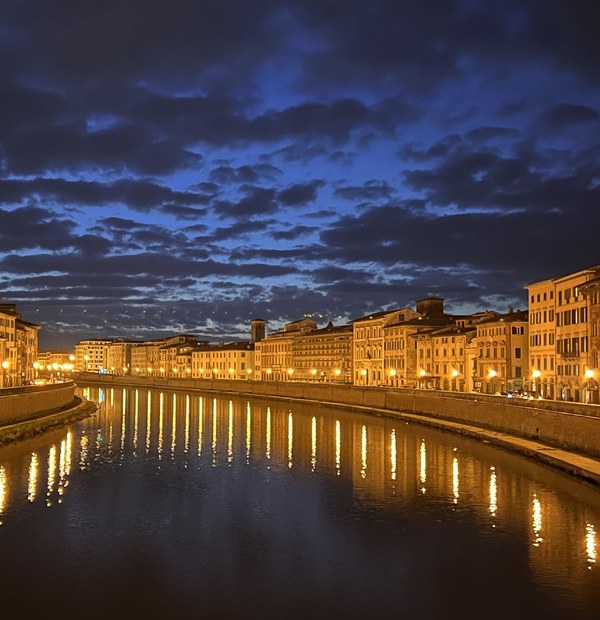
The city of Pisa grew in time around the Arno river, the main one in Tuscany, which also flows through Florence.
Therefore, the Lungarni area, around the banks of the river, is also populated with several buildings of historical interest, including:
- the former Monastery of the Benedictine Nuns, where the Conference is hosted;
- Palazzo "alla Giornata", a noble palace that is now the core of the University of Pisa, hosting the Rector, the Pro-Rectors, the Board and the Senate;
- Palazzo "La Sapienza", once the historical place of the University of Pisa, nowadays the main site of the Department of Law.
Three important museums are also found here:
- National Museum "San Matteo", featuring a collection of medieval sculptures and peculiar cross paintings;
- National Museum "Palazzo Reale", featuring a collection of more recent paintings;
- National Museum "Navi Antiche", where exceptionally well preserved wooden parts of original Roman ships are on display: these come from some sunk vessels that were recovered in the area of the ancient port of Pisa, which got buried beneath muddy soil that protected the usually perishable materials from natural disintegration.
The area surrounding Pisa is also rich in opportunities for enjoying the visit from many points of view, including historical, monumental, artistic, environmental, and gastronomic.
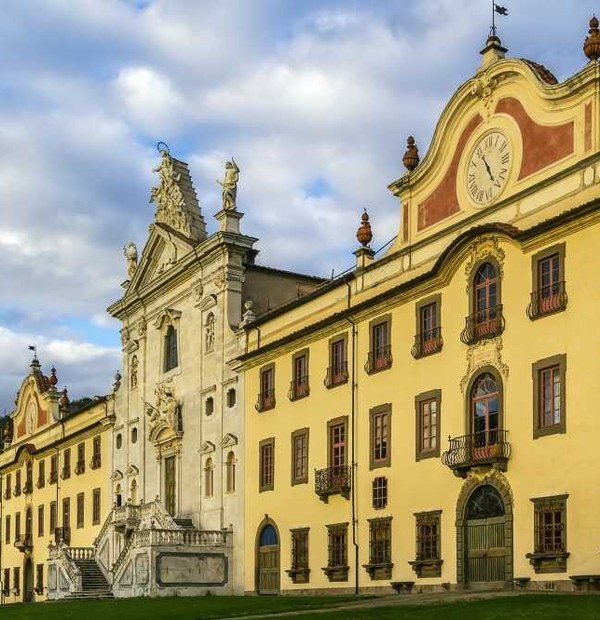
For example, the nearby village of Calci hosts the monumental Certosa di Calci, a former monks monastry presently hosting 2 museums.
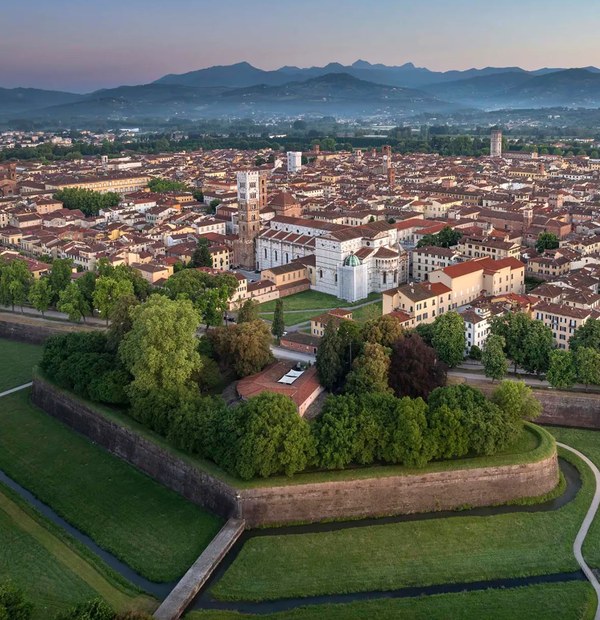
Just 20 km away, the city of Lucca deserves a particular mention, as it also features several historical buildings and one of the most impressive and best preserved examples of artillery-proof walls built during the Renaissance period.
More generally, the whole Tuscany region offers an exceptionally wide variety of opportunities to enjoy the visit featuring several major historical cities rich in beautiful monuments and museums, many cosy villages dating back to the medieval age with characteristic buildings and fortifications, and a beautiful environment ranging from sandy beaches and rocky seaside, to green countryside and gentle hills, to the massive Apuan Alps.